As a firefighting gear supplier with over a decade of on-the-ground experience supporting departments across North America, I’ve lost count of how many times crews have shown up to our warehouse unsure if their gear will stand up to the fire they’re facing. Last year, a rural fire department outside Portland brought in two sets of turnout gear, asking why one worked for grass fires and the other was built for structure blazes— that conversation stuck with me, because it’s a question we get weekly: Are there real differences in firefighting gear for different fire types? The short answer? Absolutely. And skipping those differences doesn’t just cost efficiency—it risks lives. Let’s break down what makes each set of gear unique, straight from the teams that use it and the testing data we rely on to build our products. Firefighting Gear
First, let’s start with the basics: Fire isn’t a single threat. A grass fire is nothing like a chemical fire, which is nothing like an airplane cabin fire. Each has its own unique risks, and modern firefighting gear is engineered to match those specific hazards. To understand the differences, we can break the most common fire scenarios into four categories: structure fires, wildland fires, chemical/hazardous material (HazMat) fires, and aircraft/transport fires. For each, the gear’s core components—turnout coat, pants, boots, gloves, helmet, face shield, and breathing apparatus attachments—are calibrated differently.
Structure fires are the most familiar to urban and suburban departments, and their gear is built to handle the triple threat of high heat, structural debris, and toxic smoke. When a firefighter crawls through a burning living room, they’re not just exposed to 1,500-degree flames—they’re dealing with falling ceiling drywall, molten plastic from appliances, and carbon monoxide, hydrogen cyanide, and other byproducts of burning furniture. Our structure-focused turnout gear uses a three-layer system: an outer shell of para-aramid fibers like Kevlar or polybenzimidazole (PBI) fabric, which resists tearing and doesn’t melt on contact with hot debris; a moisture barrier (usually polyurethane or Gore-Tex) to block liquid and toxic fumes from seeping in; and a thermal liner made of lightweight, heat-resistant felt that keeps wearers warm in 300-degree heat but doesn’t overheat when they’re doing strenuous work like dragging a hose. We also add reinforced knee pads and elbow patches, because 90% of a structure firefighter’s time is spent on their knees or elbows, scrubbing through small fires or pulling victims from under collapsed floors. A quick test: If you take a piece of structure gear and run it over a hot wood fire, it won’t catch a spark for at least 10 seconds, giving the firefighter time to back away. That’s the margin we design for—no guesswork, just tested, consistent protection.
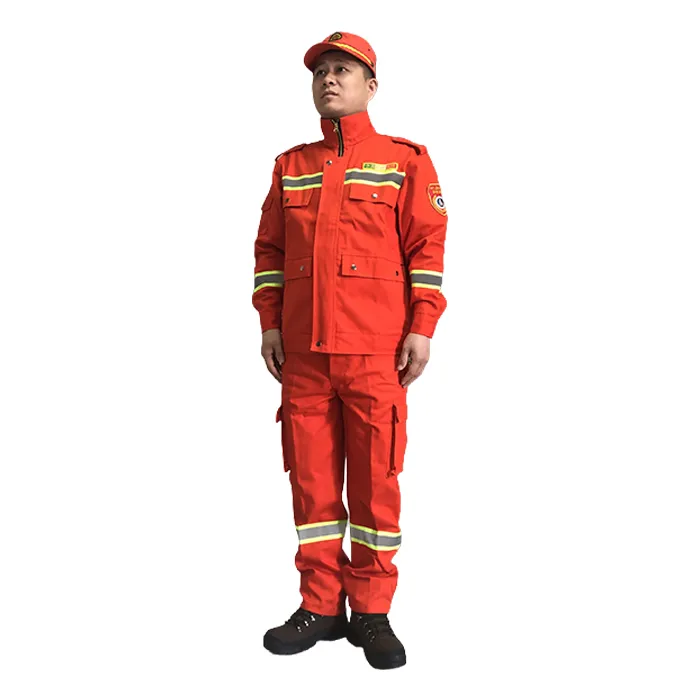
Now shift to wildland fires, where the rules change entirely. Wildland firefighters aren’t crawling through burning walls; they’re hiking miles through dry brush, often carrying 50-pound packs, working in 100-degree heat, and fighting fires that spread fast with wind. Their gear needs to be light, breathable, and flexible—none of the bulky structure gear that would weigh them down. Wildland gear, often called brush gear, uses a single-layer outer shell of ripstop nomex fabric, which is fire-resistant but far lighter than the three-layer structure setup. The moisture barrier is stripped out here because breathability is non-negotiable; a firefighter working in triple-digit heat needs to sweat to stay cool, and trapping moisture against their skin would lead to heat exhaustion or dehydration. We add flame-resistant gloves that are shorter, too—structure gloves are gauntlet-length to cover the wrist (where toxic fumes can seep in), but wildland gloves go to the middle of the forearm so crews can grab branches and tools without restriction. Helmet design is another difference: Wildland helmets have a wide brim to block embers from falling into a firefighter’s neck or face, while structure helmets are low-profile to fit under face shields and breathing masks. Last year, we worked with a fire crew in Arizona that fought a 2,000-acre blaze, and they told us their structure gear would have left them drenched in sweat within 20 minutes—their wildland gear let them work 12-hour shifts without heat-related issues. That’s the difference of matching gear to the job.
Then there’s the most specialized (and often most misunderstood) category: HazMat firefighting gear. This isn’t the gear you wear to a burning house filled with plastic toys; it’s for fires involving industrial chemicals, gas leaks, or even biological agents. HazMat gear falls into two main types: gas-tight (Level A) and splash-resistant (Level B). Level A is a full-body suit of heavy-duty polyurethane, sealed at every wrist, ankle, and neck with rubber gaskets, paired with a self-contained breathing apparatus (SCBA) that’s integrated so there’s no gap between the suit and mask. This is for fires involving volatile chemicals that can seep through fabric or be inhaled, like chlorine or anhydrous ammonia. Level B is lighter, for when the main risk is splashing chemicals (not inhalation) — it uses a thinner, flexible chemical-resistant fabric, with a face shield instead of a sealed mask. What’s interesting here is that HazMat gear is rarely interchangeable with structure gear, and vice versa. A structure firefighter trying to use a HazMat suit would be too bulky to maneuver through a burning building, while a HazMat crew member wearing a structure turnout coat would be exposed to chemical splashes or fumes that seep through the fabric. Last month, we had a HazMat team from a Texas refinery come in because their standard gear had been damaged in a sulfur fire—they told us a few years back, they tried to use structure gear for a small chemical spill and ended up with acid burns on their arms because the structure coat’s outer shell doesn’t resist corrosive chemicals. It’s a mistake we see all too often: crews cutting corners by using one gear type for all fires, which puts everyone at risk.
Aircraft fires, another high-stakes scenario, have their own unique gear too. When a plane crashes, the fire involves jet fuel, aluminum melting, and high levels of pressure from the crash impact. Aircraft firefighting gear, often called “crash gear,” is built to be both heat-resistant and impact-absorbent. The boots have steel toes and soles reinforced to handle sharp metal and broken fuselage, while the coat has extra padding on the shoulders and back to protect against being hit by debris or pushed against hot metal. The face shield is made of anti-fog, shatter-resistant polycarbonate that can withstand being hit by a flying piece of seatbelt or luggage, and the SCBA packs are mounted low on the back so firefighters can crawl under low-fuselage debris without the pack catching on anything. We also add reflective strips that glow in low light, because when a plane crashes, visibility is almost zero—crews need to spot each other through smoke and flames. A few years ago, we supplied gear to a regional airport in Florida, and after a small plane crash, the crew told us their crash gear let them pull a pilot from the wreckage in 90 seconds without getting burned, even though the jet fuel fire was still burning at 1,800 degrees. That’s the specific design work that goes into aircraft gear—nothing else would perform that way.
Now, let’s talk about the mistakes we see when crews ignore these differences. Early in my career, we worked with a small volunteer fire department in Ohio that responded to a warehouse fire. Their structure gear was old, so they grabbed their wildland gear to save time. Halfway through the blaze, a piece of burning cardboard knocked a hole in the wildland coat, and a firefighter got second-degree burns on their arm. The reason? Wildland gear’s outer shell isn’t rated for high-heat structure fires—it’s built to resist embers, not direct, sustained flames. Another story: A HazMat team in Illinois tried to use structure gear for a chemical fire at a pharmaceutical plant. The structure coat’s fabric didn’t block the corrosive drug solution they were dealing with, and two members had to be treated at a burn center. These aren’t just “oops” moments—they’re preventable, and they all boil down to not matching gear to the fire type.
So, what should you look for when choosing gear for your department? First, start with your typical response area. If you’re a suburban department that handles mostly home structure fires and wildland edge fires, you’ll need both structure and wildland gear—but you shouldn’t cut corners by buying a “universal” set. If you’re a rural department that fights 90% wildland fires, you don’t need the bulky, heavy structure gear that will slow your crews down. If you serve an industrial area with chemical plants, you’ll need HazMat gear that meets OSHA and NFPA standards—don’t settle for a suit that’s “good enough” for occasional small chemical spills.
We also offer custom fits, because one size never fits all. A 6’4” firefighter working structure fires has different needs than a 5’2” wildland firefighter who hikes 10 miles a day. Our gear is tested to NFPA standards, the national benchmark for firefighting equipment, so you know it’s been rated to withstand the specific heat, impact, and chemical risks of each fire type. We also do regular gear inspections, because even the best gear wears out after 5-7 years (structure gear) or 3-4 years (wildland gear) from exposure to heat, water, and chemicals. Skipping inspections is another common mistake—we’ve seen gear with tiny rips that turned into full-blown burns because crews didn’t check before a call.
At the end of the day, firefighting is about protecting both communities and your crew. The gear isn’t just a uniform—it’s a tool that saves lives, and when you use the right tool for the right job, you’re doing your job better. If your department is looking to update your gear, or if you’re not sure what type you need for your specific fire responses, we’re here to help. We work with departments of all sizes, from volunteer teams to municipal HazMat units, to find the right gear that balances safety, comfort, and cost.
Let’s get your department the gear that’s built for the fires you actually fight. Reach out to our team to discuss your needs, and we’ll walk you through the options, testing, and custom fits to make sure your crew is prepared for every call.
Fire Extinguisher References
National Fire Protection Association. (2022). NFPA 1971: Standard on Protective Ensemble for Structural Firefighting and Proximity Fire Fighting.
National Fire Protection Association. (2021). NFPA 1977: Standard on Protective Clothing and Equipment for Wildland Fire Fighting.
Occupational Safety and Health Administration. (2020). Hazardous Waste Operations and Emergency Response (HAZWOPER) Standards.
International Association of Fire Fighters. (2023). Firefighting Gear Selection and Usage Best Practices.
Zhenjiang Linhao Forest Fire Prevention Equipment Co., Ltd.
Zhenjiang Linhao Forest Fire Prevention Equipment Co., Ltd. is one of the most reliable manufacturers and suppliers of firefighting gear in China, featured by quality products and low price. Please rest assured to wholesale customized firefighting gear from our factory. Contact us for quotation and free sample.
Address: No.16,Fenghuangshan Road, Runzhou District, Zhenjiang City, Jiangsu Province
E-mail: lh@lhfirefighting.com
WebSite: https://www.lhfirefighting.com/
